Introduction
Spain has become one of Europe’s most strategically relevant hubs for multilingual communication. Beyond being the world’s second-most spoken native language, Spanish is the linguistic bridge connecting Europe with Latin America and the United States, a unique position that gives Spanish companies, institutions, and digital products a privileged role in global markets.
At the same time, Spain has undergone a deep digital transformation. The rise of SaaS platforms, fintech companies, mobile applications, online travel agencies, global retail brands, large-scale e-commerce, and cross-border industrial operations has drastically increased the demand for high-quality translation and localization services. Localization now influences not only brand perception and customer experience, but also product adoption, regulatory compliance, and the ability to scale internationally.
What also differentiates Spain from most European countries is its internal linguistic diversity. Alongside Castilian Spanish, three co-official languages, Catalan, Basque, and Galician, shape legal requirements, public communication, education, and administrative workflows. Public institutions, regional governments, and many private companies must operate in multiple languages simultaneously. Localization in Spain is therefore not just a commercial or operational requirement, but often a legal one.
Beyond this internal landscape, Spanish companies are increasingly active in Latin America, which amplifies the importance of variant-specific Spanish localization. While “general Latin American Spanish” is sometimes used as a baseline, sophisticated enterprises expect content tailored to major market variants such as Mexican, Colombian, Argentinian, or Chilean Spanish. This requires vendors capable of managing multi-variant Spanish content strategically, consistently, and at scale.
The rise of AI, neural machine translation, and LLM-driven workflows has transformed expectations across all industries. Yet, sectors such as finance, healthcare, legal services, regulated industries, and public administration continue to require a high level of human oversight, traceability, and compliance. ISO 18587 post-editing frameworks are becoming increasingly common among organizations seeking efficient but quality-controlled workflows.
To help organizations navigate this evolving environment, this guide provides a detailed overview of 9 leading translation and localization companies operating in Spain in 2025. The article evaluates each provider based on quality, technology, sector expertise, compliance, scalability, and overall maturity.
Whether you are a multinational entering the Spanish market, a Spanish company expanding into Latin America, or an organization operating across multilingual digital ecosystems, this overview aims to offer clarity and guidance on how to select the right partner.
Methodology
The selection in this report is based on seven key dimensions that reflect modern localization needs in Spain and across global operations. These criteria are aligned with those used in our analyses of France, Italy, and Canada to ensure consistency and comparability.
Certifications
Certifications act as important indicators of professional and operational quality. We evaluated whether companies adhere to standards such as:
- ISO 17100 for translation services
- ISO 18587 for human post-editing of MT output
- ISO 9001 for organizational quality management
These frameworks are particularly critical for regulated industries, where traceability and compliance are mandatory.
Technology maturity
Spain’s growing digital ecosystem requires providers that can integrate seamlessly into product pipelines and content operations. We assessed:
- cloud-native TMS platforms
- connectors for CMS, PIM, DAM, support centers, and code repositories
- integration with design tools and developer workflows
- neural MT + LLM-augmented pipelines
- in-context QA and linguistic testing
- terminology management system
- continuous localization workflows
Providers capable of supporting product teams, agile development, and multilingual UX at scale ranked higher.
Quality and linguistic governance
We evaluated:
- revision and review models
- LQA methodologies
- terminology governance
- editor-vs-linguist workflows
- linguistic risk mitigation
- compliance-ready documentation practices
This dimension is essential to ensure accuracy in long-form, technical, or regulated content.
Security and GDPR compliance
We assessed:
- adherence to EU data privacy regulations
- hosting location (EU data centers preferred)
- encryption standards
- confidentiality workflows
- cloud security practices
- access control and auditability
Given the sensitivity of many Spanish industries (banking, public services, telecom), security remains a key selection factor.
Industry specialization
Spain’s economic landscape is diverse and includes strong specializations in:
- tourism and travel tech
- automotive
- energy and renewables
- life sciences
- banking and fintech
- gaming and digital entertainment
- public sector and education
- retail and e-commerce
- engineering and heavy industry
Providers with sector-specific experience scored higher.
Scalability and operational capacity
We considered:
- team size and stability
- capacity to handle large projects
- multilingual program governance
- ability to scale across markets
- responsiveness and workflow transparency
Clarity of pricing and models
Transparency in pricing and scalability (including MTPE models, subscription-based TMS plans, or flat-fee systems) is increasingly important for organizations planning long-term multilingual budgets.
Localization trends shaping the Spanish market in 2025
Advanced AI integration with human validation
Spain’s companies are embracing AI-driven translation workflows, especially for large volumes or rapidly changing content. Still, regulated sectors require human oversight, ISO 18587-compliant post-editing, and clear governance models. This hybrid model is expected to dominate the Spanish localization landscape in 2025.
Co-official languages as a strategic differentiator
Adapting content to Catalan, Basque, and Galician is essential for organizations with regional presence. It is not only a matter of cultural relevance but often a legal requirement tied to public communication and institutional compliance.
Global expansion and Spanish variants
Spanish companies expanding internationally must deal with variant-specific Spanish (MX, CO, AR, CL). Providers equipped to manage variant strategy, style guides, and content governance offer a clear competitive advantage.
Continuous localization for SaaS and digital platforms
Spain’s flourishing SaaS, fintech, and gaming industries require:
- API-driven workflows
- rapid release cycles
- design-system localization
- product copy governance
- functional and linguistic testing
- in-context review for digital products
Multilingual SEO and digital growth
Spanish brands operating globally rely on SEO-localized content to support discoverability in Latin America, the US, and Europe. This requires a blend of linguistic expertise, cultural adaptation, and keyword research across markets.
Centralized, secure workflows
Organizations increasingly demand EU-based hosting, GDPR-compliant TMS platforms, secure file handling, and consolidated linguistic assets.
The 9 best translation and localization companies in Spain (2025)
(Order does not imply ranking.)
TransPerfect Spain
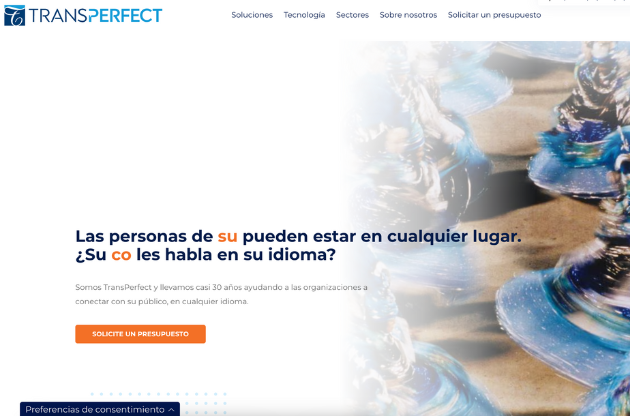
TransPerfect Spain, with offices in Madrid and Barcelona, serves a wide range of sectors including tourism, finance, retail, healthcare, industrial enterprises, and SaaS companies.
Its GlobalLink suite is considered one of the most scalable TMS ecosystems on the market, supporting workflow automation, CMS and PIM connectors, multilingual SEO, AI-assisted workflows, quality governance, and regulatory documentation. TransPerfect’s global network allows it to manage multilingual programs with operational consistency across markets, a key advantage for Spanish companies with international footprints.
Lionbridge Spain

Lionbridge Spain is particularly strong in gaming, automotive, manufacturing, software, and digital platforms. Its expertise in functional and linguistic testing makes it a preferred provider for companies requiring UX validation and product-specific linguistic evaluations.
The Spanish branch also supports high-volume technical localization, integrating AI-driven workflows, machine learning, and comprehensive human QA to adapt products culturally and linguistically.
RWS Iberia

RWS Iberia is a leading partner for regulated and technical content: pharmaceutical documentation, IP filings, clinical trial materials, engineering manuals, and scientific communication.
It manages high-stakes documentation requiring terminological consistency and compliance with EU regulations. The Trados ecosystem remains widely used among Spanish enterprises, reinforcing RWS’s role as a preferred partner for structured, large-scale localization needs.
Stoquart Spain
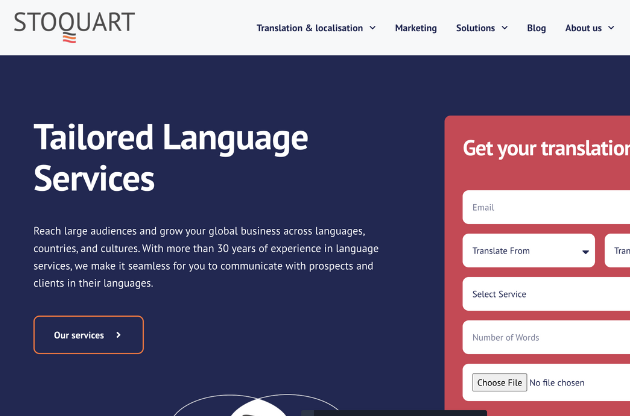
Stoquart Spain is part of the linguist-founded Stoquart group, known for its translator-centric processes, editorial refinement, and quality-driven workflows. The Spanish branch supports marketing, technical documentation, legal communication, software localization, and corporate content.
Stoquart’s workflow is built around human linguistic expertise enhanced by modern tools, ensuring clarity and stylistic precision. Its recently launched flat-rate translator-built TMS, Gingout, introduces a streamlined, frictionless approach to translation management. Gingout eliminates per-user licensing complexity, supports secure and efficient workflows, and is designed around real-world translator and project manager needs. Stoquart Spain’s use of this platform reflects its commitment to modern, quality-centric production.
Acolad Spain

Acolad Spain supports major sectors such as healthcare, finance, industry, education, tourism, and SaaS. It offers translation, localization, multimedia content, e-learning, voice-over, subtitling, and regulatory documentation.
Acolad is well known for its operational capacity and ability to manage hybrid digital + regulated content streams, making it a strong partner for large multilingual deployments.
Seprotec
Seprotec is one of Spain’s largest providers of translation, interpretation, and linguistic services for public institutions, courts, government bodies, industrial groups, and private enterprises.
It specializes in certified translations, legal content, judicial interpretation, multilingual document management, and regional language coverage. Its strong presence in public administration makes it a trusted vendor for high-responsibility linguistic operations.
AppTek.ai
AppTek.ai is the regional hub of AppTek, a leader in linguistic AI solutions. It combines speech recognition, audio analytics, neural MT, and data annotation with human validation.
It collaborates with telecom providers, media companies, digital platforms, and tech organizations integrating AI into their processes. Its hybrid model positions it at the forefront of innovation in Spain’s language industry.
Tradtec
Tradtec focuses on highly technical translation for engineering, renewable energy, construction, machinery, and industrial manufacturing. Its technical linguists handle manuals, specifications, compliance documentation, and environmental reports. The company’s strength is its rigorous terminology management and deep familiarity with industry standards.
Ontranslation
Based in Barcelona, Ontranslation specializes in marketing content, e-commerce localization, SEO adaptation, UX writing, transcreation, and cultural adaptation. The agency also covers Catalan, Basque, and Galician, making it particularly relevant for companies with multi-regional operations. Its expertise in Latin American Spanish variants also benefits Spanish companies expanding into LATAM.
Conclusion
The Spanish translation and localization market is characterized by linguistic diversity, technological innovation, global influence, and strong regulatory expectations. Organizations operating in Spain increasingly require partners that combine linguistic excellence, compliance, scalability, workflow modernity, and user-centered tools.
As multilingual workflows become more complex, teams are seeking tools that simplify processes rather than amplify them. Stoquart’s Gingout, a translator-built, flat-rate TMS, reflects this shift. Designed to streamline coordination and offer transparent, frictionless workflows, Gingout illustrates the industry’s movement toward clear, efficient, and human-centered translation management.